(858) 247-2933
Book
Book a consultation
Breast Surgery
Heavy breasts can pull on your back, neck, and shoulders every day. Breast reduction removes the extra tissue, fat, and skin behind that strain and lifts the breast into a higher, more balanced shape. Tim Sayed MD, a double board-certified plastic surgeon, sees Orange County patients at his office on MacArthur Boulevard near Fashion Island, and if your reduction is medically necessary, he provides the documentation to pursue insurance reimbursement.
20+
Years in practice
Double
Board-certified
1:1
Surgeon-led care
At a glance
What it is
A procedure to remove surplus breast tissue, fat, and skin, relieving the physical load of large breasts while lifting the breast and raising the nipple to a natural level.
Who it suits
Women in good health and at a stable weight whose heavy breasts lead to back, neck, or shoulder pain, strap grooves, or rashes.
Newport Beach cost
Self-pay usually lands between about $9,000 and $15,000, with the surgeon's fee, anesthesia, and accredited facility fees included. If the reduction is medically necessary, insurance may offset some of it.
Procedure time
Same-day outpatient surgery under general anesthesia, lasting about 2.5 to 3 hours.
Recovery
Most patients return to desk work in 1 to 2 weeks and to full exercise by about 6 to 8 weeks; the final shape emerges over several months as swelling settles.
Provider
Tim Sayed MD, MBA, FACS, certified by both the American Board of Plastic Surgery and the American Board of Surgery, in practice for more than 20 years.
Think of the three breast operations this way: augmentation adds volume, a lift repositions what you already have, and a reduction removes volume and weight to ease symptoms while lifting the breast in the same procedure.
The procedure
In a reduction mammaplasty, the medical term for breast reduction, Dr. Sayed removes surplus tissue, fat, and skin and reshapes the remaining breast so it is smaller, firmer, and higher. The nipple and areola are moved up to a natural position while staying connected to their own blood supply, which helps preserve feeling and often the ability to breastfeed. The operation takes about 2.5 to 3 hours under general anesthesia, and you recover at home that evening.
Relief, more than appearance, is why most women seek a reduction. Oversized breasts strain the neck, back, and shoulders, leave grooves where straps press in, hold moisture that causes rashes beneath the fold, and make exercise and dressing harder. Reducing the weight usually eases those symptoms, and the lift built into the operation leaves the breasts higher and in better proportion.
Is size really the issue? If you are content with your size but bothered by sagging after pregnancy or weight change, read about breast lift. If you want more fullness, breast augmentation is the procedure to consider.
Candidacy
Good candidates are usually women whose breasts are heavy enough to cause physical symptoms, who want lasting relief and a smaller, lifted shape, and who are healthy and at a stable weight. At your consultation in Suite 320, Dr. Sayed evaluates your breast size, skin, and nipple position, documents your symptoms, and confirms whether reduction is the right operation for you.
have chronic back, neck, or shoulder pain from heavy breasts
deal with bra-strap grooves, rashes, or irritation beneath the breasts
are in good health and holding a stable weight
do not smoke, or will stop all nicotine for several weeks before and after surgery
feel limited by your breast size at the gym, at work, or in bed, and have realistic goals and time to recover
expect to have children later, since another pregnancy can enlarge the breasts and change the result
are nursing, or finished less than 6 months ago
are still losing a lot of weight; reaching your stable weight first is the better order
mostly dislike sagging rather than size, which suggests a breast lift
want to be fuller, which suggests breast augmentation
Since breast reduction is both medical and aesthetic, expect a frank conversation with Dr. Sayed about how much tissue can safely be removed, where the scars will go, and how insurance may respond if your symptoms qualify.
Your options
Few aesthetic operations are considered medically necessary as often as breast reduction. If heavy breasts cause symptoms that are on record, part of the cost may be reimbursed, so understanding coverage before your consultation is worthwhile.
A reduction may count as medically necessary when chronic pain, grooving, or rashes persist despite conservative treatment. When appearance is the main reason, it is cosmetic and self-pay. Many women are a mix of both, and the consultation clarifies where you fit.
Insurers usually require documented symptoms, several months of conservative treatment such as physical therapy or supportive bras, and a minimum amount of tissue removed according to your body surface area. Dr. Sayed takes the measurements and records them during your visit.
The practice does not bill insurance directly for breast reduction. You receive the itemized procedure and diagnosis codes plus operative documentation so you can file with your carrier for out-of-network reimbursement. With Medicare, you may need to sign a self-pay waiver.
Each policy has its own rules, so bring your insurance details with you. Dr. Sayed documents your symptoms at the consultation and explains both the medically necessary and the self-pay route.
A reduction is about relief as much as looks. When symptoms are real and well documented, that record can support an insurance claim for part of the cost.
How it works
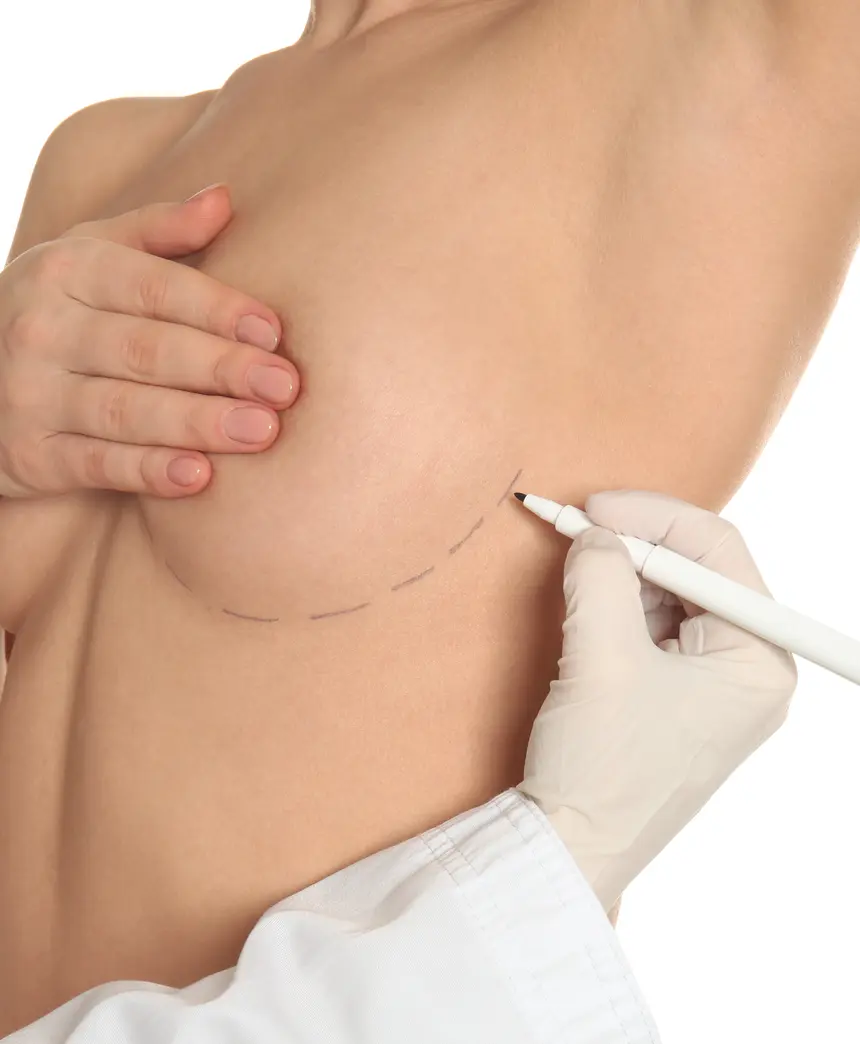
Surgery takes place under general anesthesia at an accredited Orange County surgery center and typically lasts about 2.5 to 3 hours. Markings are made while you stand. Dr. Sayed then removes excess tissue, fat, and skin one quadrant at a time, keeping the nipple on a pedicle of tissue that maintains its blood supply, raises the nipple and areola, shapes the smaller breast, and closes in layers. Three choices drive your result: incision pattern, nipple attachment, and how much tissue comes from each side.

Liposuction only. Suited to fatty breasts with minimal sagging; volume is reduced with liposuction through tiny incisions.
Lollipop. Used for moderate reductions, with a scar circling the areola and a vertical scar to the crease.
Anchor. The most common approach for large reductions and significant sagging, combining the areola and vertical scars with a third along the crease.
Pedicle. Lifting the nipple without detaching it from its blood supply and nerves helps preserve sensation and, often, breastfeeding.
Areola size. A stretched areola is typically reduced so it fits the smaller, lifted breast.
Symmetry. Each breast is measured and planned separately, because few pairs start out the same size or in the same position.
Free nipple graft. For an exceptionally large reduction, the nipple may occasionally be removed and grafted back; Dr. Sayed has needed this in only a couple of cases.
Amount removed. How much tissue comes out is planned around symptom relief, a safe blood supply, and a natural shape.
Combined procedures. Other procedures can be added to the same operation if it is safe.
Sagging without extra size is better treated with a breast lift, and added fullness calls for breast augmentation. For every other option, see breast surgery at Tim Sayed MD.
Cost
Across Orange County, self-pay breast reduction usually totals about $9,000 to $15,000, covering the surgeon's fee, general anesthesia, and accredited facility fees. If your reduction is medically necessary because of documented symptoms, insurance may reimburse some of it and reduce what you pay out of pocket. Your exact price depends on how complex the reduction is, and you receive it as a written quote after the consultation.
Self-pay generally runs about $9,000 to $15,000. Insurance reimbursement may lower that if your symptoms meet your carrier's criteria, and the written quote from your consultation is the exact figure.
Complexity. More tissue to remove and more reshaping add operating time and raise the fee.
Technique. Liposuction alone is less surgery than a full anchor reduction, and the total reflects that.
Anesthesia and facility. Board-certified anesthesia care and an accredited surgical facility are both part of the quoted price.
Surgeon experience. The fee reflects more than 20 years in practice as a double board-certified plastic surgeon, experience that can help make results more predictable.
For a medically necessary reduction, Dr. Sayed supplies the codes and documents needed for an out-of-network claim. Monthly financing is available for self-pay costs, and our plastic surgery pricing page shows typical fees ahead of your visit.
Recovery
Relief from the weight often comes almost at once. Plan on about 1 to 2 weeks before desk work and around 6 to 8 weeks before full exercise. Early swelling is considerable and settles over the following weeks, and the final size and shape take several months to appear. Dr. Sayed gives you a written plan before you leave and stays involved through every stage.
Day of surgery
Same-day discharge in a supportive surgical bra; medication manages soreness and swelling.
First week
Rest and keep arm movement limited. Bruising, swelling, and soreness peak, then start to improve.
Weeks 2 to 4
Desk work and light activity are fine. Wear the surgical bra Dr. Sayed recommends, not an underwire.
Weeks 4 to 6
Increase activity gradually as you are cleared at follow-up visits; full exercise and heavier lifting usually return around 6 to 8 weeks.
3 to 6 months
Swelling largely resolves, scars keep fading, and you see your final, smaller, lifted shape.
Sleeping. Sleep on your back and slightly propped up for the first few weeks so the breasts heal undisturbed.
Driving. Most patients wait about 10 days, until they are off prescription pain medication and can move without discomfort.
Exercise. Walks are encouraged from the start; save chest and upper-body work for when you are cleared at around 6 to 8 weeks.
Scars. Expect pink, firm incision lines at first that soften and fade over 6 months to 2 years; Dr. Sayed advises on scar care as you heal.
Breastfeeding. With the nipple kept attached to its tissue, many patients are still able to breastfeed, but there is no guarantee.
The surgeon
Breast reduction is a balance: removing enough tissue to relieve symptoms while protecting the blood supply and keeping a natural shape. Tim Sayed MD brings more than 20 years of practice to that balance. He is double board-certified by the American Board of Plastic Surgery and the American Board of Surgery and trained at UCSF, Harvard, and Massachusetts General Hospital. He plans your operation, performs it, and follows your recovery himself.
Dr. Sayed is also nationally known for breast implant removal and breast implant illness care, delicate work that relies on the same respect for tissue, blood supply, and incision placement as a well-done reduction. Before you decide, review his credentials and results.
American Board of Plastic Surgery
American Board of Surgery
Fellow, American College of Surgeons
20+ years in practice

The area
The Newport Beach office is at 3991 MacArthur Boulevard, Suite 320, close to Fashion Island and John Wayne Airport, and patients come in from across Orange County, from Corona del Mar and Costa Mesa to Irvine, Huntington Beach, and Laguna Beach. For the regional overview, see breast reduction in Southern California, or explore all of our breast surgery.
Orange County life happens outdoors, from the Newport and Corona del Mar beaches to Back Bay trails, Pilates, and year-round time on the water, and breast reduction is planned to make all of it more comfortable once you heal. Because the coastal sun can darken fresh scars, Dr. Sayed asks every patient to keep incisions covered and out of direct UV for the first several months; good sunscreen makes that simple.
3991 MacArthur Boulevard, Suite 320
Newport Beach, CA 92660
Get directions to the Newport Beach office on Google Maps
Typical drive times to the office
Fashion Island
5 min
Corona del Mar
9 min
Costa Mesa
6 min
Irvine
9 min
Balboa Island
12 min
Laguna Beach
16 min
Book a private consultation with Tim Sayed MD in Suite 320 on MacArthur Boulevard. You will walk out with a clear recommendation, a direct answer on whether reduction suits your goals, documentation of your symptoms for insurance if they qualify, and a written quote.
Questions
Across Orange County, self-pay breast reduction typically totals about $9,000 to $15,000, which covers the surgeon's fee, general anesthesia, and accredited facility fees. Insurance may reimburse part of the cost when documented symptoms make the surgery medically necessary. The office provides codes and documentation for an out-of-network claim, and your exact price comes in a written quote after the consultation.
In many cases, yes, if the reduction is medically necessary. Carriers may cover part of it when heavy breasts cause documented pain, grooving, or rashes that conservative treatment has not relieved. Reductions done mainly for appearance are cosmetic and self-pay. Dr. Sayed's office does not bill insurance directly; it provides the procedure and diagnosis codes and operative notes for your out-of-network reimbursement claim.
Insurers commonly ask for documented symptoms such as back, neck, or shoulder pain, grooving, or rashes; evidence that you tried conservative treatment like physical therapy or supportive bras for several months; and removal of a minimum amount of tissue based on body surface area. Dr. Sayed measures and documents each item at your consultation so you can submit a complete claim.
Desk work usually resumes in about 1 to 2 weeks, with clearance for full exercise around 6 to 8 weeks, and many women feel relief from the weight almost immediately. You head home the same day with written instructions and should not drive for about 10 days. Over several months, swelling settles and your final shape appears.
Many women can, since the nipple remains attached to its underlying tissue, ducts, and blood supply. Still, no breast operation guarantees breastfeeding, and sensation or milk supply can change. If you hope to breastfeed later, tell Dr. Sayed so he can tailor the technique.
The results are long-lasting: removed tissue does not grow back, and most patients keep their relief and smaller shape for many years if their weight stays stable. Pregnancy, major weight gain, and natural aging and gravity can change breast size again over time.
Lightening the breasts typically relieves chronic back, neck, and shoulder pain, deep bra-strap grooves, and rashes or irritation beneath the breasts, and it makes exercise, posture, and dressing easier. Many patients notice the lighter weight the moment they wake up.
There is no hard age cutoff. Teens with severe symptoms are occasionally candidates, though it is usually better to wait until breast development is finished, and healthy adults of any age may qualify. Dr. Sayed reviews timing and development with you at the consultation.
Scars circle the areola and, with some techniques, extend down to the crease and sometimes along it; liposuction-only reductions leave just small marks. They begin pink and raised, then typically soften and fade over 6 months to 2 years. Dr. Sayed positions incisions so bras and most swimwear hide them and guides your scar care, though scars never fully disappear.
Expect soreness and swelling over the first several days rather than sharp pain; the medication Dr. Sayed prescribes usually keeps you comfortable, and most patients stop prescription pain medicine within a few days. You go home the same day in a supportive surgical bra. Many patients find the relief from the weight is worth the discomfort of healing.
Choose a plastic surgeon certified by the American Board of Plastic Surgery who performs reductions often and can show before and after photos of their own patients. Find out who does the operation, who prepares your insurance paperwork, and who sees you through recovery. Tim Sayed MD is double board-certified, has more than 20 years in practice, and personally sees every patient from consultation through healing.
Patient Reviews