
At a glance
Total capsulectomy and en bloc capsulectomy both remove the entire scar-tissue capsule around a breast implant. The difference is the sequence.
- Total capsulectomy: the whole capsule is removed, and the implant is taken out separately during the same surgery.
- En bloc capsulectomy: the implant and the full capsule are removed together as one intact unit, so the contents stay contained.
- Which is used: depends on the thickness and health of your capsule, your reason for removal, and what is safe for your anatomy. En bloc is not required for every patient.
First, what a capsulectomy actually removes
A capsulectomy removes the capsule of scar tissue your body forms around a breast implant. A capsule is normal; the surgery is about taking it out along with the implant.
Whenever an implant is placed, the body walls it off with a thin layer of scar tissue called a capsule. For most people that capsule stays soft and causes no trouble. In some, it thickens, tightens, or calcifies over time, which can change how the breast looks and feels. When you decide to remove your implants, your surgeon also decides how much of that capsule to take out, and that decision is what the words partial, total, and en bloc describe.
A capsule is the layer of scar tissue the body naturally forms around any breast implant. Capsulectomy is the surgery that removes it.
Total capsulectomy, defined
In a total capsulectomy, the surgeon removes the entire capsule and takes the implant out separately during the same operation.
Total capsulectomy removes all of the scar-tissue capsule, not just part of it. The order is what sets it apart from en bloc: the implant may be removed first and the capsule dissected out afterward, or the capsule is opened during removal. The end result is the same amount of tissue removed as en bloc, a complete capsule and the implant, just not necessarily in one connected piece. It is a common, well-established approach and is often the safest choice when a capsule is thin or adhered to important structures like the ribs or chest muscle.
En bloc capsulectomy, defined
In an en bloc capsulectomy, the implant and the entire capsule are removed together as a single intact unit, without opening the capsule inside the body.
En bloc, a term borrowed from surgical oncology, means removing a structure in one continuous piece. Applied to explant surgery, it means the capsule is kept closed around the implant and the whole unit is lifted out together. Because the capsule is not opened inside the body, anything held within it, such as silicone from a ruptured implant, stays contained during removal. Achieving a true en bloc removal depends on the capsule being thick and intact enough to hold together, which is not the case for every patient.
En bloc capsulectomy removes the implant and the entire scar-tissue capsule in one intact piece; total capsulectomy removes the whole capsule too, but takes the implant out separately.
The difference in one view
Partial, total, and en bloc capsulectomy sit on a spectrum of how much capsule is removed and in what sequence. Here is how they compare side by side.
| Partial capsulectomy | Total capsulectomy | En bloc capsulectomy | |
|---|---|---|---|
| Capsule removed | Part of the capsule | The entire capsule | The entire capsule |
| Implant and capsule | Removed separately | Removed separately | Removed together as one unit |
| Capsule opened in the body | Yes | Sometimes | No |
| Often chosen when | Remaining capsule is thin and healthy | Capsule is thin, or adhered to ribs or muscle | Capsule is thick or calcified and holds together |
| Technical demand | Lower | Moderate | Highest |
How the removal is performed
Both procedures are performed under general anesthesia at an accredited surgical facility, usually as an outpatient. The incision is most often placed in the fold under the breast, which gives the surgeon direct access to the capsule and tends to heal to a well-concealed line. Small drains are frequently used afterward to clear fluid from the space where the implant and capsule sat, and the removed capsule is typically sent to pathology.
The judgment happens during surgery. Your surgeon assesses the capsule in real time and performs the most complete removal your anatomy safely allows, which may be en bloc, total, or a combination across the two breasts. Removing a thin or calcified capsule intact is one of the more technically demanding parts of breast surgery, so training and experience matter here.
Does en bloc matter for breast implant illness?
If you are considering removal for symptoms you associate with breast implant illness, current evidence does not show that en bloc is required to feel better. What matters most is complete, safe removal of the capsule.
Breast implant illness, or BII, is the term for a cluster of symptoms such as fatigue, joint pain, brain fog, and anxiety that some people associate with their implants. If you are experiencing these symptoms, your experience is real and deserves to be taken seriously. Many patients report meaningful improvement after explant surgery. At the same time, the science connecting implants to these symptoms is still developing, and researchers have not established that one removal technique produces better symptom outcomes than another. A careful total capsulectomy and an en bloc capsulectomy both remove the entire capsule. The right choice is the one that removes it safely and completely for your anatomy. You can read more on the breast implant illness page.
Both en bloc and total capsulectomy remove the entire capsule. Current evidence does not show that en bloc is necessary for symptom relief.
Which approach is right for you
The best approach is the one matched to your capsule and your goals, and that is confirmed in a consultation, not chosen from a menu in advance. Rather than requesting a specific technique by name, it is often more useful to ask your surgeon to remove the capsule completely and safely, and to explain what they found and did afterward. If loose skin is a concern once the implants are out, a breast lift at the same time can restore a lifted, natural shape.
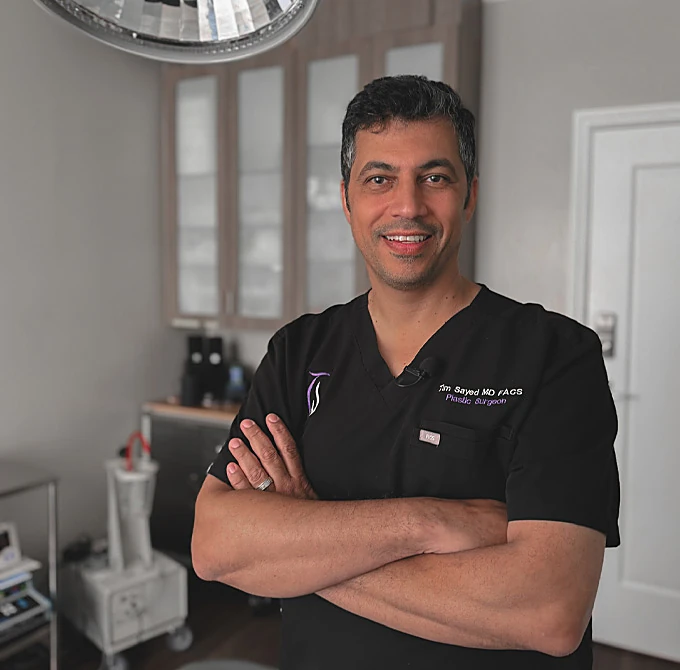
Tim Sayed MD performs total capsulectomy and en bloc capsulectomy when it is safe and appropriate, and talks through the plan with you beforehand. He cares for explant patients at his La Jolla and Newport Beach offices. To see the full procedure, recovery, and pricing, visit the breast implant removal and explant surgery page.
En bloc vs. total capsulectomy FAQs
Is en bloc capsulectomy better than total capsulectomy?
Neither is universally better. Both remove the entire scar-tissue capsule; en bloc removes it together with the implant as one unit, while total removes the capsule and implant separately. The right choice depends on the thickness and health of your capsule and what is safe for your anatomy, which your surgeon assesses during surgery.
Do I need en bloc removal for breast implant illness?
Current evidence does not show that en bloc is required for symptom relief. What matters is complete, safe removal of the capsule, which a careful total capsulectomy also achieves. Many patients report improvement after explant regardless of the exact technique. Read more on the breast implant illness page.
What is the difference between en bloc and total capsulectomy?
Total capsulectomy removes the entire capsule, with the implant taken out separately during the same surgery. En bloc capsulectomy removes the implant and the full capsule together as one intact unit, without opening the capsule inside the body.
Is en bloc capsulectomy always possible?
No. A true en bloc removal depends on the capsule being thick and intact enough to stay together in one piece. When a capsule is thin, or adhered to the ribs or chest muscle, a total capsulectomy is often the safer choice and removes the same amount of tissue.
Is the capsule sent to pathology?
Yes, the removed capsule is routinely sent for pathology, with the report typically returning about a week after surgery. Small drains are often used afterward to clear fluid from where the implant and capsule sat.
Where does Tim Sayed MD perform explant surgery?
Tim Sayed MD sees explant patients at his La Jolla office near San Diego and his Newport Beach office in Orange County. See the breast implant removal and explant surgery page for procedure, recovery, and pricing.